Between June and July 2018 my friend Alisa and I travelled around Japan for several weeks. We started our trip in Tokyo, staying there for four nights before heading to Nikko. After staying in Nikko for two nights, we started a road-trip through central Japan, driving from Nikko to Kusatsu, a town famous for its onsens.
Our plan was to stay in Kusatsu one night. The next day we would head straight to Yamanouchi to see some of the country’s wildlife. Before that, we would try to see the crater of Mount Kusatsu-Shirane, an active volcano located not far from Kusatsu.
Mount Kutatsu-Shirane is known for its crater lake filled with turquoise blue water. It’s also a popular hiking spot, with trails that give people access to some of Japan’s most stunning mountain views.
Seeing a volcano crater was high on my Japan bucket list. The closest I had ever been to an active volcano was when I went to Reunion Island in 2004. That year I hadn’t been able to reach the top of the volcano to see the crater. At ten years old I didn’t have the energy to walk long hours. The weather also got worse as we walked up to the crater, making it impossible to see anything. Japan has dozens of volcanos so it was with some excitement that I drove off to Yamanouchi.
There was just one problem. Mount Motoshirane, another volcano close to Mount Kusatsu-Shirane, had erupted in January. Due to the eruption, the ground had become unstable around Mount Kusatsu-Shirane, so the local Japanese authorities closed off access to the crater lake. The road to Mount Kusatsu-Shirane was closed. Or so I thought…
Indeed, one of the roads leading up to Mount Kusatsu-Shirane was closed but there was another much longer route we could take to reach Yamanouchi. That meant our road trip from Kusatsu to Yamanouchi was going to take much longer than initially planned. What was supposed to be a 1h 15 minute trip to Yamanouchi was going to be a lengthy 3-4hr trip. But to my pleasant surprise, the second road we had to take was also going to lead us straight to Mount Kusatsu-Shirane anyway. The second road had not been closed by the local authorities because doing so would have made it impossible for locals to get around.
So after a few hours of driving, we reached a small parking area on the side of the road right next to the volcano. The weather wasn’t great. It was windy and cloudy. The rain was also headed our way so we only had a small window of opportunity to see the volcano crater. I estimated that it would only take us an hour to see the crater and then walk back to the car. Visibility was still good, and we weren’t parked too far away from the crater. Despite the weather, I thought our chances of getting lost were slim.
Getting to the crater
From the carpark, we couldn’t see where the crater lake was. There wasn’t a clear walking trail up to the volcano. The official trail was located on the other side of the volcano, closed off to tourists. The only thing I could use was google maps to give us a sense of direction. To see exactly where the crater lake was, we needed to reach the top of the volcano.
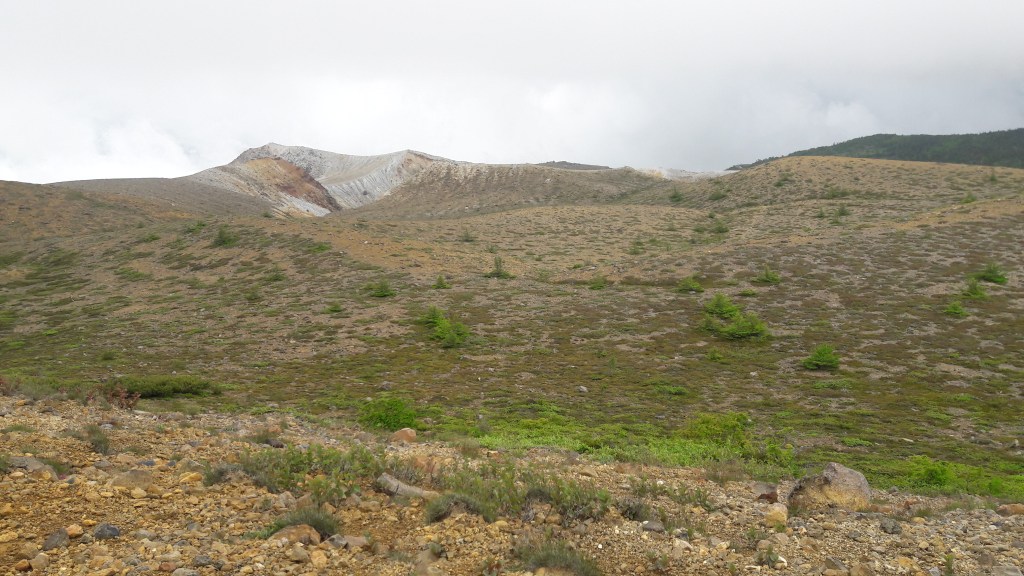
Reaching the top only took us 5 to 10mn. I didn’t really know where the lake actually was so I thought climbing up the edge of the crater would give me an immediate view of the lake. But that wasn’t the case. From where we were standing, we could still see our car behind us. To our left, the road towards Yamanouchi. We could also see a steep ditch between the road and the volcano: a reminder that if we made any mistake up here, we would surely regret it. To our right: the road that we had just taken. And in front of us: barren land. A good indicator that we were well and truly on an active volcano. From our position, we could see several craters in the area. The crater I had come here to see was about 15mn away.
Heading towards the crater lake I noticed a thin white cord laid out on the ground. I assumed this was used by local hikers to get around the area but in some places, it was buried under the rocks.
The walk towards the crater lake was deceptively simple. The weather hadn’t changed and visibility was still good. But a part of me felt that I hadn’t put ourselves in the best of situations. Poor visibility on a mountain can be dangerous for hikers, especially on a volcano. Hikers can get lost in poor weather, some of them sustaining severe injuries trying to find their way out. I kept an eye on the weather, making sure that we could make our way safely back to the car.
As we got closer to the crater I could only help but notice how quiet it was. There were no birds or insects, just silence.
And then we saw it.
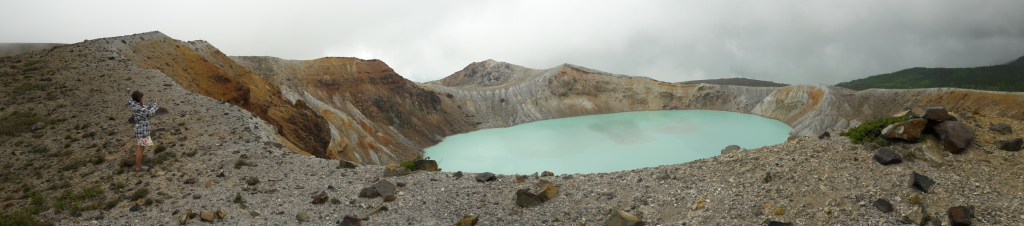
The Crater Lake
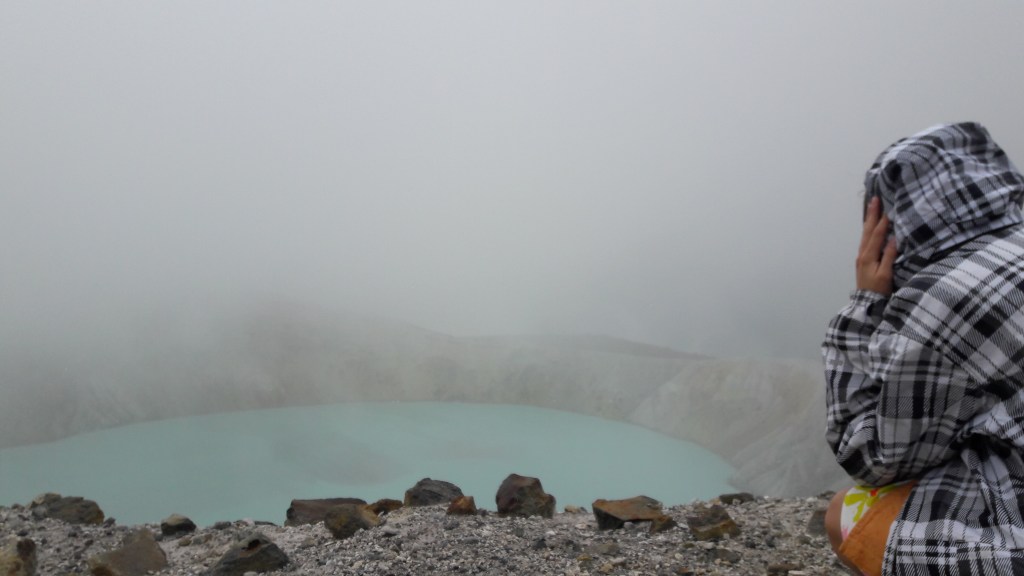
I was initially surprised at how close we were. We had walked right up to the crater edge and there was no safety barrier to prevent us from falling in. I warned Alisa not to get too close. The last thing I wanted was for us to fall inside the crater.
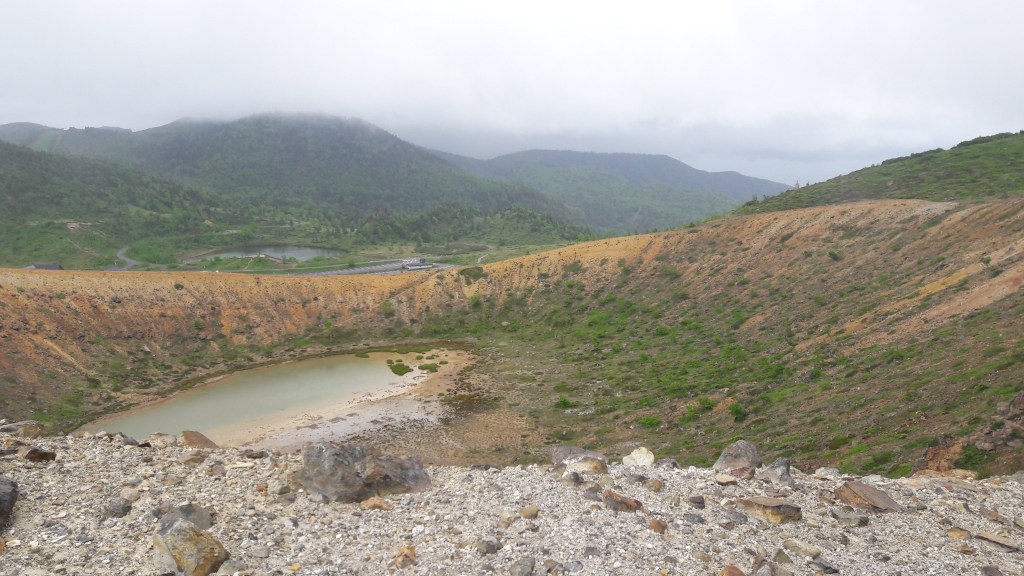
The view was amazing. The turquoise blue water of the lake contrasted so vividly with the harsh landscape around us. The clouds made the scene even more surreal. This amazement quickly turned to fear as I thought about how dangerous this was for us. Alisa and I were way too close to the sulphur lake.
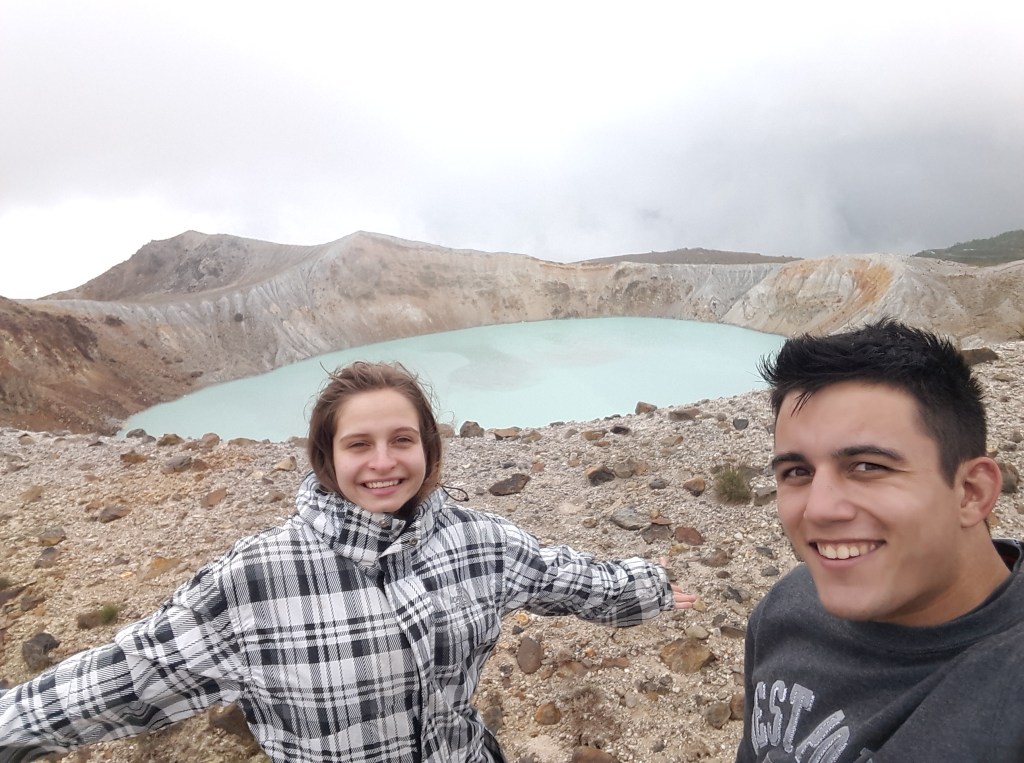
The weather gets worse
Half an hour later we started making our way back to the car. Falling into the crater was no longer our concern and the risk we had taken seemed to have paid off. But whilst we were taking pictures of the lake the weather had gotten worse. Visibility was poor as the clouds settled in. We couldn’t see anything beyond 20m and everything looked the same. The only positive? It wasn’t raining yet.
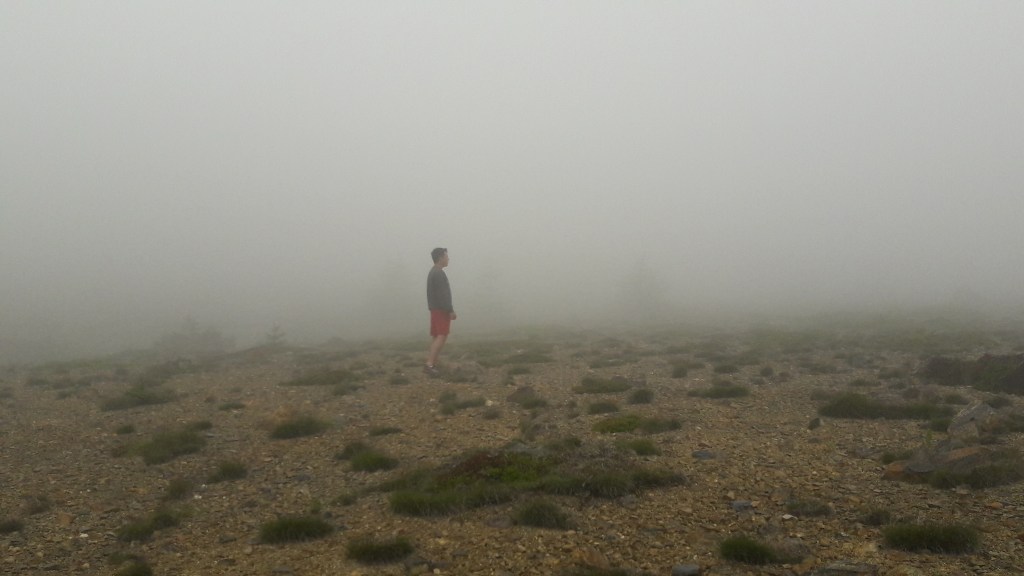
Making our way back to the car soon became a struggle. Apart from a dried-up pond, there were no other major defining features we could rely on to make our way back to the car. I still had google maps to guide me, but with no internet, relying on my phone wasn’t going to be enough.
I remember seeing the large mound of rocks that we had climbed over to reach the top of the mountain. But I had underestimated its height and I thought that wasn’t the right direction. That’s when I realised we were lost.
Finding our way back
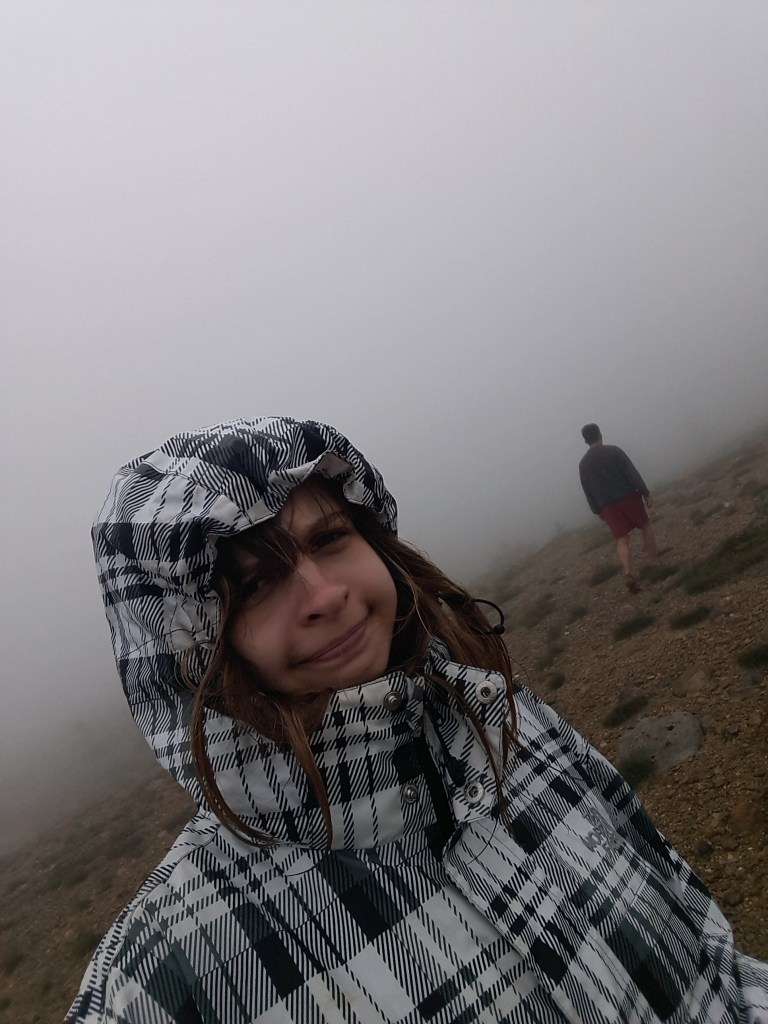
I had lost track of time at this point. We were walking towards the sound of cars as we got closer to the road. Alisa was confident that if we followed the sound of the cars we would be able to find our car. But I knew that if we kept doing this we were going to put ourselves in an even more difficult situation. Although the sound of cars gave us some reassurance, I also remembered the ditch I had seen earlier on our way to the crater lake. Relying on the sound of cars wasn’t a good idea.
But I didn’t have a clear plan so I followed Alisa. Visibility was so poor we still couldn’t see how close we were to the car. The terrain kept getting steeper, so I tried to convince Alisa that we weren’t heading in the right direction. I thought our best option was to walk back to where we came from.
I decided that trying to find the white cord on the ground I had seen earlier would be our best bet. If we found the cord, that would lead us back to the car. Somehow, I managed to convince Alisa to follow me without getting into an argument. Tired, cold, with no proper hiking gear, she had stayed remarkably calm. I’m glad she trusted me because soon afterwards I found the cord. I was relieved when that happened.
We followed the cord up the slope, and with another stroke of luck, the clouds opened up again for a split second. That’s all it took for me to see our car down below. And then again, the clouds engulfed us once again.
Relieved, I made my way down the slope to the car. Alisa, also relieved and happy to see that we had made it back, made were way down the mountain as well. As soon as we reached the car, it started pouring rain. There’s no telling how miserable we would have been on the mountain had it been raining.
Conclusion
What should have been a one hour hike to and from the crater became a struggle that lasted several hours. I might be exaggerating how long we spent on the mountain. I did lose track of time when we were lost. But getting back to the car definitely took much longer than it should have.
Although we did make it back to the car, Alisa was dehydrated and became carsick as I drove to Yamanouchi.
This was a memorable experience for Alisa and I. In just a few hours we had been mesmerised by the beauty of Mount Kusatsu-Shirane, only to find ourselves lost and worried that we wouldn’t make it off the mountain safely.
It was a valuable lesson for both of us. Especially for me. Mount Kusatsu-Shirane had been one of my most anticipated destinations in Japan. Yet I made a rookie mistake, failing to take bad weather more seriously.
It’s easy for me to say that things weren’t that bad and that we would have found our way back eventually. But the outcome could have been very different.
Today, the Mount Kusatsu-Shirane viewpoint still remains closed off to tourists. Hopefully, it will reopen soon. When this happens, I highly recommend making your way to Gunma prefecture to see this volcano. Gunma prefecture is a stunning place to visit. Surprisingly very few tourists come to Gunma prefecture when they visit Japan. If you plan on coming to Japan, make sure you include Gunma prefecture in your travel itinerary. It’s a beautiful place.
 Sabaidee Travel
Leave a comment